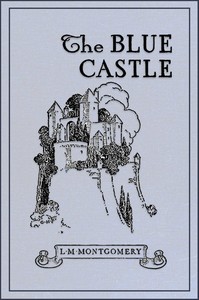
I don’t think I’ve heard of this title before, or maybe I did, but I never picked it up, so I forgot about it. A few days ago, I found this lovely post with a link to Project Gutenberg where you can start reading. It’s only some 200 pages, and it hooks you from the first page. The author is Lucy Maud Montgomery.
“I’m 27 years old, I’ve no money and no prospects. I’m already a burden to my parents, and I’m frightened”. No, this isn’t The Blue Castle. This quote is from the 2005 Pride and Prejudice film adaptation. But Valancy checks all the boxes. You know, the ones on a cake everyone keeps humorously getting for their birthdays to see how much they relate to P&P’s Charlotte. But yes, give it to candles. Let the fire take it away.
Actually, scratch that! Valancy is 29, but “I wouldn’t proclaim it from the house-tops if I were you, dear.” There’s this juxtaposition to her state where she’s kept under a glass bell, treated as a child (in so many places throughout the book she was called a child or a girl!), and pitied because she’s an old maid with no one to want her.
She’s not very beautiful, but she’s always been so obedient. And, if Providence would have it that she ends up an old maid, she wouldn’t be sad about it. But the pain was in the fact that there never was any choice for her to be anything else.
“I’ve had nothing but a second-hand existence,” decided Valancy. “All the great emotions of life have passed me by. I’ve never even had a grief. And have I ever really loved anybody? Do I really love Mother? No, I don’t. That’s the truth, whether it is disgraceful or not. I don’t love her—I’ve never loved her. What’s worse, I don’t even like her. So I don’t know anything about any kind of love. My life has been empty—empty. Nothing is worse than emptiness. Nothing!”
The Blue cASTLE
At one point, her uncle tells her that she’s not like herself, and Valancy, who by that point has had enough, asks back: “Who am I like, then?” A childish, frail creature, called Doss by her entire family – quiet pointedly so, and despite her being bothered by it – and an old maid, a running joke in her family, whose job was to smile and never talk back.
We start in a blue mood. Valancy is crying, and we’re about to hear gossip, because “it did rain and you shall hear what happened to her because of it.” And, oh, how I related to Valancy, tired of “the chilly, gloomy little dining-room”, and a stagnant life.
The author is somewhere like a fly on the wall, and from times we hear from her. That’s why it felt so intimate, jabbering, very Bridget Jones-esque, and – taunting for poor Valancy, who just wanted to be left alone with her Blue Castle.
Because, as we find out, “Valancy had two homes—the ugly red brick box of a home, on Elm Street, and the Blue Castle in Spain.” Although calling them a home is a stretch. The Blue Castle (it had to be blue) is a fantasy that changes like a fever dream, and the ugly red brick box is a domestic prison, void of love.
And so the days go by for Valancy as she daydreams about the perfect life where she does get married, and does have children, and does have a little place of her own. And while her life isn’t filled with the grief of failed loves, her heart does break. It breaks over a fate of unlived life.
And then, on that rainy day on her 29th birthday, Valancy has had enough. Or, as her clan concluded, she became severely feverish. She, who never received any letters, received one that turned her life upside down. Or better yet, prompts her to do it.
Valancy, who spent her whole life being afraid of something, asks herself: “What if?” and whatever answer she hears back, she does it. It seems at the time, for her family and society, that Valancy did something improper, mad, and scandalous, but we see that it’s simply not true. She did some unconventional things, but it is all still polished and justified, and the ending ties it into a nice bubble of redemption in front of society.
Even her spiritual guide, when presented first in the story, sounded like an author of an improper text, who would require censorship. That was my guess. It happened to be none of it. John Foster – as that was his name – is just a passionate nature enthusiast.
He does, however, play an important part in Valancy’s breakthrough. Or, one of his quotes does. “Fear is the original sin,” wrote John Foster. “Almost all the evil in the world has its origin in the fact that someone is afraid of something.”
And Valancy was afraid, but was there really any consequence to her actions? She managed to accomplish everything unconventional, and still follow all the rules and order. Nevertheless, it cannot be denied that she did overcome her fear. And I guess that it is true that love heals all.
At the beginning of the story, Valancy is wilting away, just like the rose bush she planted, but never had any ownership over.
Really, I’m surprised at you. And to do it without consulting me!”
The Blue Castle
“The bush is mine,” muttered Valancy.
“What’s that? What did you say, Doss?”
“I only said the bush was mine,” repeated Valancy humbly.”
She takes to uprooting it, taking it down, because why won’t it bloom? And throughout the story, she does much the same to herself. A desperate last chance to bloom, and it does pay off.
“Look at my rosebush! Why, it’s blooming!”
The Blue Castle
It was. Covered with blossoms. Great, crimson, velvety blossoms. Fragrant. Glowing. Wonderful.
And still, there’s a daunting (or maybe that’s a bit dramatic) line that lingers over the plot. “She had changed so much—and it had changed so little.” Maybe it was in reference to the ugly red brick box, but really, it was a veil over the entire story. Her family, the values, the order of things, the society standards, everything stayed pretty much in its lane, with a brief, adventurous episode that in the end didn’t stir much.
It was a lighthearted romance (not Valancy falling in love with a guy, but falling in love with life) with one really interesting moment, actually. What would happen if, for example, you found out you’re dying, went on a spree of doing the things you always wanted to do, and then found out you’re not dying? How would you deal with that? Do you go on living freely? Does it seem reckless and unsustainable now, in the aftermath? Do you keep it up?
What would happen if you one day decided that from that day on, you would only do the things you want to do? Valancy decided to embark on that journey. So we have our answer. Sometimes you can bring your fantasies to life.
I enjoyed the humour in this book, too. I’d love to see this in an adaptation, like a nice little sitcom. It was a fun read, and you cannot not root for Valancy.
Discover more from My Little Hawk
Subscribe to get the latest posts sent to your email.
 My Little Hawk
@mylittlehawk.com this was my mother's favourite book, I think because the main character rebels against a domineering mother
LikeLiked by 1 person
Remote Reply
Original Comment URL
Your Profile
Why do I need to enter my profile?
This site is part of the ⁂ open social web, a network of interconnected social platforms (like Mastodon, Pixelfed, Friendica, and others). Unlike centralized social media, your account lives on a platform of your choice, and you can interact with people across different platforms.
By entering your profile, we can send you to your account where you can complete this action.
I can see why she liked it. Maybe it brought inspiration where it was needed!
LikeLike