
You can read about places, but there is a point where you reach the limit of what you can take in without actually being there.
My first semester abroad experience was in Santiago de Compostela, which, for most people, is famous for the pilgrimage. A lot of people who heard I was going there thought I was doing the Camino.
But anyway, my neighbors are planning a trip to Fatima, Portugal, and they will stop by Santiago on their way back.
Of course, that place is near and dear to me. It’s a beautiful, foggy, rainy oasis of calmness. During my time there, I learned so much about the whole region. It is truly a beautiful region with such rich history (part of it, especially for Santiago, being that the pilgrimage was started by the European aristocracy and royalty who, in the Middle Ages, could afford the pilgrimage/travel, hence the inflow of gold in the region).
When I heard they were going there, I considered it my time to shine. I spent half a year there. I could prepare them for everything they need to know/visit/do/try.
And it got me thinking, among other things, about coffee. Coffee is very important in the Balkans, so I figured I might have a few recommendations for them.
Now back to that initial thought about learning about places.
In all my time there, I didn’t have good coffee. Or, actually, it wasn’t to my liking. I tried many cafes. I prepared it myself in my accommodation, but something about it was peculiar to me.
Now, when I prepared my coffee, keep in mind I was a student, so it was all budget-friendly. There was this type called mezcla. This isn’t a brand. It’s a type of coffee, and I knew it meant “mixed”.
It didn’t occur to me to ask about this or consider that there might be a reason for this coffee type. I took it at face value, as I was used to the coffee back home.
This was a long introduction to tell you about mezcla, a blend of roasted natural beans, which make up about 70% of the mix, and torrefacto.
Torrefacto beans are made by coating the beans in sugar in the final stages of roasting. It was done to prolong the coffee supply and lower the cost in the post-Civil War era. Today, it is more like a custom, something the locals are used to and prefer in terms of taste.
Sugar cannot caramelize at such high temperatures. Instead, it leaves a coating that is burned black and tastes a bit bitter, creating the effect of stronger coffee.
Had I tried the coffee and didn’t like it, I would have concluded that Spain doesn’t have good coffee (which would be a gross exaggeration anyway, because I haven’t been to all of Spain, and there are other options besides mezcla).
This way, I saw, tried, and learned a bit about the history I knew virtually nothing about. It would never have occurred to me that this would be a reason, but now it highlighted what it means to know a place, what it means to travel, and to travel intentionally.
(I spent years after wondering about this coffee until I found out why.)
Discover more from My Little Hawk
Subscribe to get the latest posts sent to your email.


And I’m sure that’s a satisfying order.🤩 Right! We can’t just declare that the country has poor coffee entries if we never traveled all around. Wonderful, Katarina.
LikeLike
This is exactly it, a coffee cup holding centuries of history. You could have concluded Spain just doesn’t make good coffee, but instead you stayed curious. And years later, mezcla finally told you its story: sugar and survival and what a whole nation learned to love. That’s the difference between visiting and actually being somewhere.
LikeLiked by 1 person
Exactly, I would’ve made an assumption based on my reality, which is the coffee standard back home, which would’ve been entirely dismissive to this new place that has it’s own story. That’s what I love about travel the most: to be able to actually meet new places and learn.
LikeLiked by 1 person
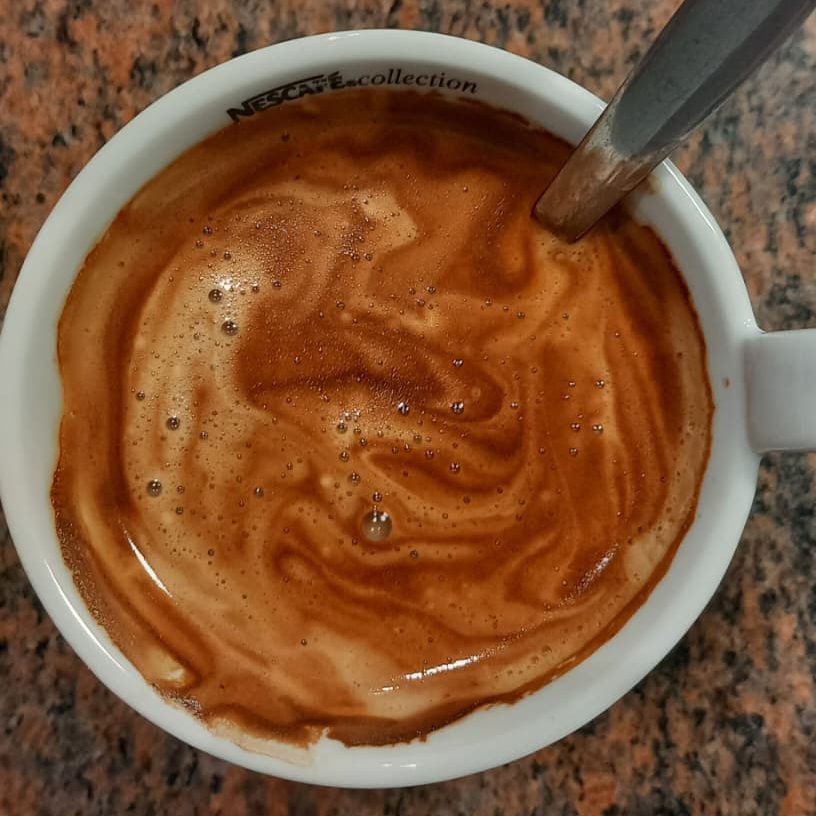
Sugar used to be a preservative back in the day maybe this was how it was stored and the flavour profile was a side effect. I only assume of course there might be other reasons. Great looking coffee is it a latte?
LikeLiked by 1 person
That’s exactly it in this case, from my understanding. I linked to a site that talked about it, too. Obviously, there’s a broader context both in the historical sense and nowadays with the coffee culture. But you’re right, yes!
It’s coffee with milk 😅 Here, we say “velika, toplo” which literally means coffee in a big cup with warm milk (creating foam). Latte isn’t really my thing, I only like milk in small amounts, if any, in my coffee 😅
LikeLiked by 1 person
Ooh nice!
LikeLiked by 1 person
Was reading more on torrefacto beans turns out its not done to arabica beans but only to robusta beans and arabica-robusta hybrids. I like arabica beans but most instant coffee is robusta. I don’t mind the harsh taste though. What is your preference in beans?
LikeLiked by 1 person
Thanks for sharing! Love that I’m still learning about this 😄 But robusta is cheaper, and torrefacto is a result of cost cutting during the war, so it tracks that they would also go for cheaper beans.
Well, the one that is the most popular and most used in my household is Franck Jubilarna, which is a brand that blends arabica and robusta. That one is very popular in the Balkans and we prepare it in kogula/džezva, which is a small metal pot to prepare Turkish coffee in. How do you prepare your coffee?
LikeLiked by 1 person
We use instant robusta coffee lol I do have some Arabica coffee at home which comes from Kerala which is a state in south India. You need a muslin cloth to filter it after brewing it because the powder is very fine. Traditionally it is made in a giant kettle which is similar to an Italian coffee kettle in function but much larger. Its not practical for home use hence the cloth. Such a coffee is called filter kapi and is made with milk and sugar. Its served from a tap specifically to create froth on top.
LikeLiked by 1 person
Wow, that’s so cool! I’m obsessed with the coffee culture around the world! Now I’m reading about coffee in Kerala. Soooo coool!! I’m loving the etymology of kapi, too!
We usually leave the coffee sludge inside the pot, and also in out mugs, but it’s used for reading out of coffee, so that’s why. And also it’s a very fine powder that stays at the bottom of the cup, so we don’t mind.
Filter kapi sounds sooo good, by the way!
LikeLiked by 1 person
Filter Kapi is amazing! Its cool how things evolve differently in different places eh? reading out of coffee as in fortune? i hear there is a way to read fortune from cups or am I just a fan of Harry Potter?
LikeLiked by 1 person
I bet! It’s so fascinating! And yes, reading as in fortune telling. It’s taken very seriously, although I never see anything except like shapes in the same way you could see them in the clouds. But, I have other ways to compensate, so it’s fine. 😅 Does HP mention reading out of a cup?
LikeLiked by 1 person
Yes Prof. Trelawney teaches it in Prisoner of Azkaban☕️ now I’m nerding out hehe
LikeLiked by 1 person
Oh, yeah! You’re right! 😅 I’m not totally unfamiliar with the HP world. I’m just very forgetful 😬 *and* I collected all the funko pop figures from Kinder Joy with my sister 😅 Go for it! 😂
LikeLiked by 1 person
Oh that’s so cool! I don’t have the figures but I have books 4 and 5 those are probably my favourite parts as well. 😄
LikeLiked by 1 person
I like the cozy vibes of the movies, and I had the first three books, but I gave them to my sister cuz she loooves HP. I never read it when I was a kid, when HP mostly becomes a favorite to many because of nostalgia. I didn’t have that, so I was already outside of the audience window, and couldn’t connect with it when I started reading later, but it is a well known and loved world. I’m not really vibing with the author, tho, so in this case, I’m choosing movies over books, but also just for ambience and as a fun shared love with my sister. 4 and 5 are great, tho! 😄
LikeLiked by 1 person
The first two and the fourth movies are pretty book accurate I’d say. Its pretty big lore so I get if you didn’t get into it I’m the same with GoT and LoTR. Cheers!🫶😄
LikeLiked by 1 person
Oh, GoT I know virtually nothing about, never read, never watched, but I really like LoTR, both books and movies! Cheers! 😄
LikeLiked by 1 person
I really enjoyed this. 🤍 Sometimes the smallest things, even a cup of coffee, can tell us so much about a place and its history. Such a lovely reminder that travelling is about experiencing, not just seeing.🦋✨
LikeLiked by 1 person
I’m glad you did! 😊 You’re absolutely right! Small details can tell a whole story. It’s the enriching beauty of travel. 🤍✨
LikeLike
Where’s mine? That looks delicious
LikeLiked by 1 person
Thanks! Come join 😁
LikeLike
wow that cup of coffee looks so good and i didn’t know about the mezcla! thanks for dropping knowledge on us today
LikeLiked by 1 person
thankss actually i made that cup of coffee while i was working in this one restaurant 😊 mezcla was the cause of my curiosity for years since i tried it until i found out the story behind it, so i had to share. turns out, we can start a whole conversation on coffee especially bc we’re all from different places and also i’m such a coffee lover
LikeLike